Navarra incorporates three new high throughput DNA sequencing systems to advance the use of the human genome as a key tool for precision medicine
Navarra is incorporating three new high-throughput DNA sequencing systems to advance the use of the human genome as a key tool for precision medicine, increase diagnostic rates and accelerate research and the development of new therapies, within the framework of the IMPaCT-Genómica 2 programme. This cutting-edge biomedical research project on rare diseases and cancer places Navarra at the European forefront in this field.
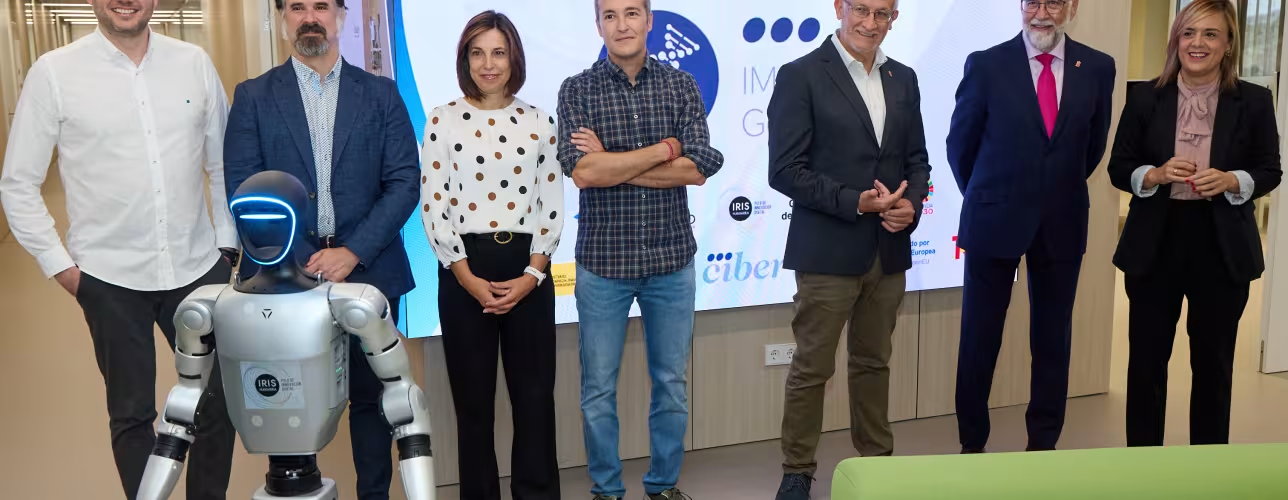
The First Vice President and Minister of Presidency and Equality, Félix Taberna; the Minister of Health, Fernando Domínguez; and the Government Delegate in Navarra, Alicia Echeverría, visited the Synthetic Biology, Molecular Biology and High-Throughput Sequencing Laboratory located at the IRIS Innovation Hub.
During the visit, Taberna underscored the regional government’s commitment to the IMPaCT-Genómica 2 project: “Pride. That is the word that sums up our visit to the IRIS Hub. Pride in the scientific and research staff who, through their collective effort, place Navarra on the map of excellence. This is the Navarra we want and defend: a community that stands for knowledge, talent and the common good.”
The Vice President recalled that “research and personalised medicine are part of the five political priorities set out in the Government’s policy agreement for a progressive and plural Government of Navarra.” He also linked this project to the framework of the 2030 Agenda, highlighting that “personalised medicine is strategic for achieving Sustainable Development Goal 3 (Good Health and Well-Being), by developing more effective and accessible treatments for highly complex diseases.”
For his part, Councillor Domínguez emphasised that “with this technological leap, the Government of Navarra reaffirms its vocation to place itself at the European forefront of biomedicine. And we do so with a clear purpose: to prioritise clinically vulnerable groups, particularly people affected by rare diseases and cancer patients who require highly complex diagnostics.” He added, “as I always say, behind every number there is a person, a family, a story. Being able to provide more accurate diagnoses at moments of great clinical uncertainty is a qualitative leap for our system in its care for patients.”
Government Delegate Alicia Echeverría also took part in the visit. It should be remembered that the IMPaCT-Genómica 2 project is funded by the Ministry of Health and the Ministry of Science, Innovation and Universities. Echeverría highlighted the Spanish Government’s commitment “to the modernisation and transformation of our community,” particularly, she said, “in areas as sensitive as health and research, to offer citizens the best and most cutting-edge public services.”
The Government Delegate stressed that this is an innovative and ambitious project in the field of rare disease and cancer research. She also noted that it enables “the strengthening of high-quality knowledge generation and transfer within the National Health System, ensuring scientific-technical excellence, equity and efficiency in the use of available resources.”
The visit was also attended by Javier Gómez-Arrue, Director of the Miguel Servet Foundation – Navarrabiomed; Agurtzane Martínez, Director General of Science, Technology and Innovation; Luis Campos, Managing Director of Nasertic; Gonzalo Rodríguez Ordoñez, Director of Personalised Medicine and Laboratories at Nasertic; and Ángel Alonso, coordinator of the IMPaCT project in Navarra.
More than 1,100 fully sequenced genomes analysed in Navarra
The IMPaCT-Genómica 2 project, coordinated in Navarra from Navarrabiomed by Dr Alonso, continues the infrastructure launched by the Carlos III Health Institute and the Biomedical Research Networking Centre (CIBER).
Its first phase, carried out between 2021 and 2024, aimed to consolidate equitable and efficient access to Personalised and Precision Medicine through the creation of a national network of genomic sequencing and analysis infrastructures, involving Nasertic / Navarrabiomed, the National Centre for Genomic Analysis in Barcelona and the Fundación Pública Galega de Medicina Xenómica in Santiago de Compostela. The project supported the diagnosis of more than 3,000 patients with rare diseases and cancer through the sequencing and analysis of complete human genomes, 1,100 of which were performed in Navarra.
In this new phase, the consortium—made up of 67 research groups and 260 professionals from 31 hospitals and 19 research centres—expands the technologies used by incorporating RNA sequencing, long-read DNA sequencing, optical mapping and functional genomics. Its aim is the genomic and molecular characterisation of highly complex undiagnosed cases, the advancement of innovative therapies and the resolution of variants of uncertain significance.
Furthermore, the new sequencing systems installed at the IRIS Innovation Hub are integrated with Nasertic’s supercomputing cluster, ensuring fast and efficient processing and secure data storage. For the Government of Navarra, the protection of genomic data is a fundamental ethical principle.
The project also places emphasis on translating results into the National Health System through the health systems of the Autonomous Communities and on promoting citizen participation through patient associations and platforms.
IRIS Hub, Navarra’s Silicon Valley
The IRIS Hub, managed by the public company Nasertic and located in the El Sario building, brings together Navarra’s expertise in innovation and digitalisation. It acts as a one-stop shop for technological transformation for companies, universities, technology centres and public administrations, with the aim of accelerating digitalisation and strengthening Navarra’s competitiveness.
Luis Campos, Managing Director of Nasertic, underlined the importance of this commitment: “Scientific research is the engine that has allowed humanity to improve its quality of life and open horizons that once seemed unreachable. That is why every euro invested in research is a euro invested in health, well-being and shared hope. And we do so from the public sector because what is built through collective effort must ultimately benefit all citizens of Navarra.”
Among its most notable resources, the IRIS Hub houses Synthetic Biology, Molecular Biology and High-Throughput Sequencing laboratories, with 215 square metres of space and state-of-the-art equipment. These facilities offer advanced services in genomic analysis and DNA synthesis and aim to position Navarra as an international benchmark in synthetic biology, with applications in biomedicine, food, energy and information technologies.
Source: navarra.es


