VIDAAS Centre obtains certification from the European Network of Living Labs, the world’s largest network of innovation labs
The VIDAAS Centre— Navarra’s Centre for Vanguard Innovation in Active, Autonomous and Healthy Development —has obtained certification from the European Network of Living Labs (ENoLL), the world’s largest network of innovation laboratories.
The certification was approved following ENoLL’s General Assembly, held recently, after VIDAAS presented its model as a laboratory specialised in the social sphere, focused on improving people’s quality of life and autonomy throughout their life cycle through technology. It is worth noting that ENoLL (European Network of Living Labs) is the largest international, non‑profit network focused on promoting Living Labs as open, user‑centred innovation environments.
Obtaining this certification serves and recognition of the VIDAAS Centre’s quality and methodological soundness, consolidating the centre as a hub for social and technological innovation, oriented toward creating inclusive solutions applied to real problems and challenges. Likewise, joining this global Living Lab network will give VIDAAS the opportunity to access European projects and collaborative opportunities with other leading research and development entities in the social field.
It should also be noted that with this certification VIDAAS—promoted by the Department of Presidency and Equality and managed through the public company NASERTIC—becomes the first public entity in Navarra to receive this kind of recognition. At present, only two private entities in Navarra hold this certification: the Asociación de Daño Cerebral de Navarra (Adacen) and the training centre Campus by IDEA, both of which also collaborate actively with the VIDAAS Centre.
VIDAAS Projects and Equipment
The report submitted by the VIDAAS Centre for Living Lab certification includes information on both ongoing and completed projects. One example is “Retos IA – Artificial Intelligence at the Service of People,” an initiative carried out following the Living Lab methodology in three phases: a first phase to identify real needs related to accessibility, communication and the use of spaces by people with specific needs; a second phase in which inclusive solution proposals and designs were developed to meet those needs; and a final phase in which specialised companies’ technological proposals were defined. The entire process focused on the active participation of end users such as older adults, people with disabilities and care professionals.
Also notable is the participatory session held on 14 October 2024, in which citizens, social entities, universities and companies defined expectations and priority challenges. A total of 120 people took part in this meeting, whose results were directly incorporated into the VIDAAS 2025 Strategic Plan, setting the Living Lab’s roadmap.
It is also worth highlighting VIDAAS’s participation in the UMANA project, an initiative aimed at establishing a new model for the labour integration of people with intellectual disabilities, facilitating their entry into the job market in technological environments through Social Initiative Special Employment Centres.
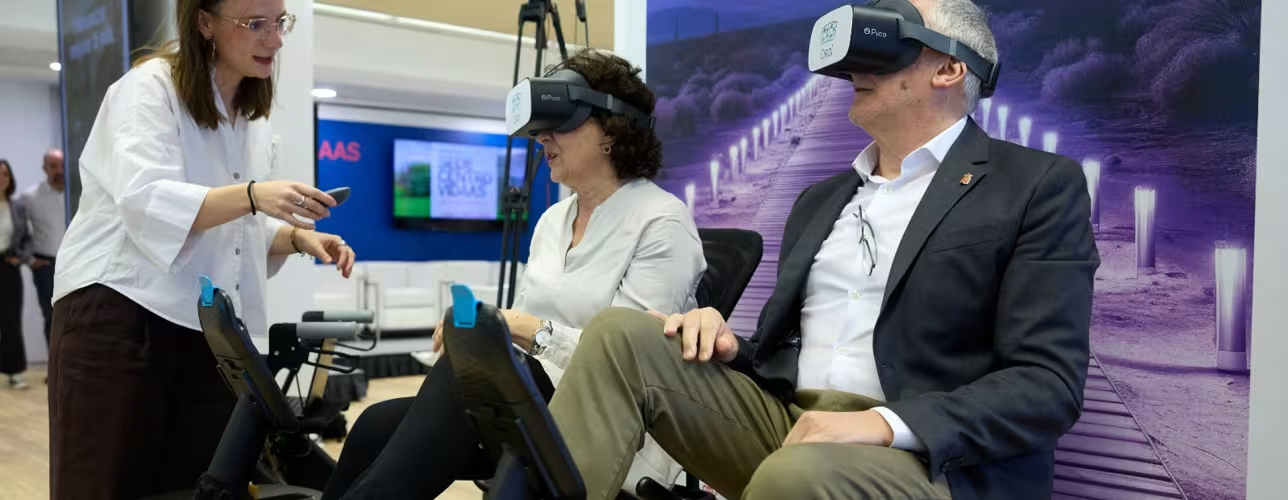
The centre also provides equipment and tools to third-sector organisations, such as virtual reality glasses, whose service combines device lending with training and follow‑up, ensuring equitable and safe use.
VIDAAS Centre, a Pioneering Space at the Service of People
The VIDAAS Centre, attached to the Directorate General of Planning, Coordination, Innovation and Evaluation of Public Policies, is a pioneering space that combines research, experimentation and knowledge transfer to develop solutions that promote autonomy, accessibility and inclusion for all people.
The centre’s working methodology is based on collaboration and on promoting the active participation of citizens, companies, social entities and public administration in projects, creating an ecosystem that responds to current social challenges.
Its headquarters, recently inaugurated in Sarriguren, has facilities covering 800 square metres distributed among a large co‑working space, three experimentation rooms with advanced infrastructure, a training room and two meeting rooms, all open to any entity or organisation in the social innovation ecosystem that needs them. The facilities are fully accessible and have the necessary elements and conditions (access, spatial layout and signage) to ensure inclusion and safety for all users.
For its part, ENoLL (European Network of Living Labs) is the largest international, non‑profit network focused on promoting living laboratories, or Living Labs, as open, user‑centred innovation environments. Founded in 2006, it is headquartered in Brussels and has 170 members across more than 40 countries worldwide. One of its main functions is to certify Living Labs that meet methodological quality standards, evaluating aspects related to their strategy; their organisational and governance model for decision‑making; the services, equipment and infrastructure they have; the projects they develop, promote or collaborate on; the impact of their activity; and partnerships, among others.
Source: navarra.es


