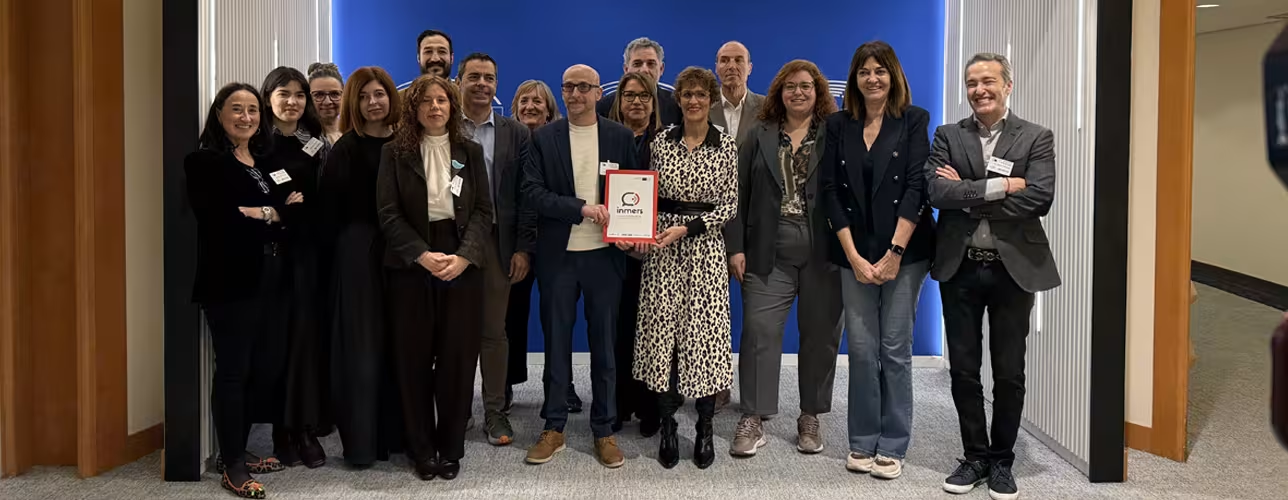
President Chivite inaugurates in Brussels the launch of the European INMERS project to strengthen media literacy for older people in rural areas
a { text-decoration: none; color: #464feb; } tr th, tr td { border: 1px solid #e6e6e6; } tr th { background-color: #f5f5f5; }
The President of the Government of Navarre, María Chivite, inaugurated at the European Parliament in Brussels the official launch session of the European project INMERS (International Media Literacy – Empowered Rural Seniors), an initiative funded by the Creative Europe programme (CREA – Media Literacy) aimed at strengthening media literacy among people over 65 living in rural areas of Europe. The project is led by the Directorate-General for Planning, Coordination, Innovation and Evaluation of Public Policies within the Department of Presidency and Equality.
The event was held within the framework of the European Committee of the Regions and brought together all consortium partners from Navarre, Finland and Romania, as well as institutional representatives such as Navarre’s MEP Elena Sancho, accompanied by Idoia Mendia, Rosa Serrano and Marcos Ros, also representatives of the European Parliament.
During her speech, President María Chivite stressed that “media literacy is not a technological matter, but a democratic one,” and noted that “in a context of disinformation, polarization, and the proliferation of digital scams, strengthening the critical capacity of older citizens means protecting their autonomy and dignity.”
As the President highlighted, “at a time when trust in institutions and in truthful information is a fundamental pillar for democratic stability, strengthening media literacy means strengthening Europe. A saying holds that the first casualty of war is truth. And in these turbulent times, marked by vociferous leaderships and empires that believe they can impose their truth through bombs and diplomatic bullying, I want to champion the Europe of the Enlightenment—once a beacon for the free world, and called to become so again—because nowhere else in the world has achieved comparable levels of well-being, quality of life, security, social justice and progress. Let us assert ourselves as Europeans, in our plurality, with the power of words. Faced with the noise of bombs, democracy,” she said.
Chivite also stressed that INMERS addresses structural challenges shared by European regions such as Navarre, Lapland and Transylvania: population ageing, territorial dispersion and the digital divide, with special attention to multilingual contexts.
“Territorial cohesion and digital cohesion go hand in hand. We cannot speak of a strong Europe if we leave out those who most need support in accessing information,” she stated.
The project will operate over two years in three pilot territories—Navarre, Lapland and Transylvania—to assess the level of media literacy among older people, analyse vulnerabilities to disinformation, design adapted training materials, develop practical workshops and produce a European Media Literacy Guide.
Local trainers will also be trained to ensure the project’s sustainability, and the impact of the actions will be assessed, with results disseminated at the European level.
The meeting was attended in person by representatives of the Directorate-General for Planning, Coordination, Innovation and Evaluation of Public Policies of the Department of Presidency and Equality, the University of Navarre, the University of Lapland, the Romanian organisation Funky Citizens, and the Institute of Constructive Journalism of Navarre, as well as the public company NASERTIC. The remaining partner entities followed the session online.
The programme included the institutional presentation, an overview of the project, presentations of the work packages, and the definition of forthcoming milestones and the implementation schedule.
Navarre, a leading region in European projects with social impact
To close her remarks, Chivite highlighted that participation in European programmes makes it possible to expand the impact of public policies beyond regional borders and to strengthen the voice of regions in European debates on digitalisation and territorial cohesion.
“Europe is not built only from its capitals; it is also built from its regions. And Navarre wants to be an active part of that construction,” she affirmed.
INMERS is co-funded by the European Union under the Creative Europe programme and seeks to promote autonomy, social participation, and critical thinking among older people in rural areas.


