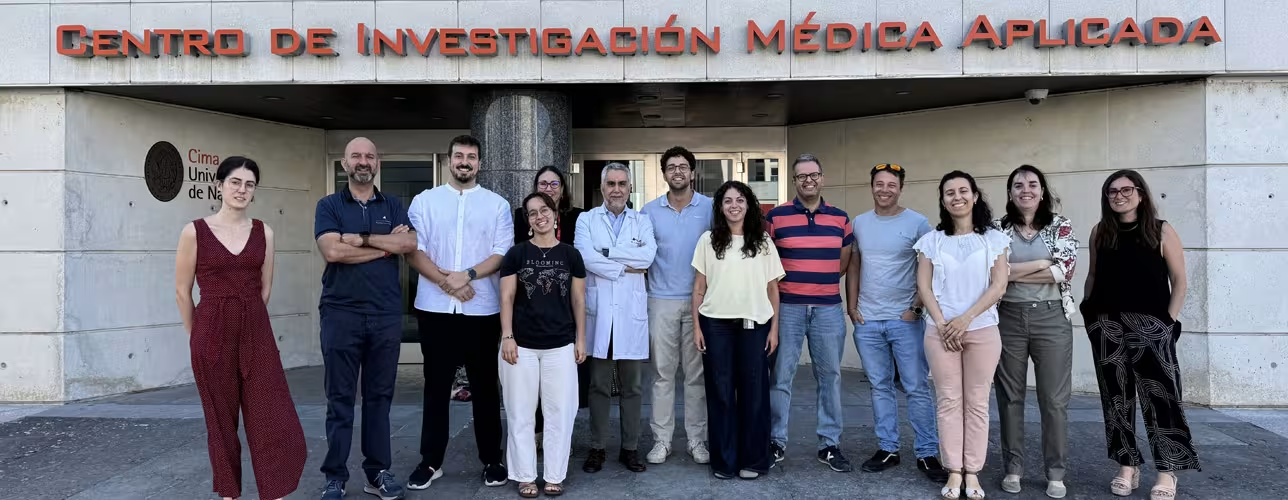
SYNTHBIOMICS Concludes with New Synthetic Biology Tools for Health, Food Safety, and Decarbonization
The SYNTHBIOMICS project, focused on disruptive Synthetic Biology innovations to advance health, food, sustainable energy, and industrial decarbonization, has concluded after more than two years of collaborative research. Coordinated by FIMA/Cima University of Navarra, the project brought together seven Navarre-based entities to develop biotechnological solutions in strategic fields. The Department of Industry and of Ecological and Digital Business Transition awarded €1.46 million to this project, which focused on the SIBERIA biotechnology challenge, through the latest 2023-2026 Strategic R&D Projects call.
Coordinated by the Foundation for Applied Medical Research (FIMA), through Cima University of Navarra, the consortium included the participation of CNTA, CENER, NASERTIC, Stirling Center–MC3, TAIREL DATA, and NUCAPS Nanotechnology. Their joint work enabled SYNTHBIOMICS to address three major areas: the development of synthetic nanobodies with diagnostic and therapeutic potential; the generation of new recognition elements for biosensors aimed at detecting food contaminants; and the modification of microorganisms capable of transforming carbon-rich gases into valuable chemical compounds.
The project’s principal investigator and Scientific Director of Cima University of Navarra, Dr. Antonio Pineda-Lucena, stated that “SYNTHBIOMICS has demonstrated that Navarra has complementary capabilities to tackle complex synthetic biology projects, from DNA design and synthesis to functional characterization and the potential valorization of results.”
The project concludes with new libraries, candidates, modified strains, prototypes, methodologies, and infrastructures that reduce technological uncertainty and establish a solid foundation for future initiatives. Next steps will include individual validation of selected nanobodies and aptamers, cellular evaluation of targeted nanoparticles, improvement of biosensors, and optimization of microbial pathways for the utilization of carbon-rich gases.
Different Technologies Serving a Common Goal
In the health field, Cima built a synthetic nanobody library using yeast display systems, with a diversity on the order of ten million variants. Procedures were also optimized to select, sequence, produce, and characterize candidates capable of recognizing different biomedical targets. TAIREL DATA developed the artificial intelligence-supported bioinformatics system required to process more than one hundred million reads and obtain nearly 87 million validated sequences, while NASERTIC contributed personnel and advanced infrastructure for the various techniques and procedures involving massive sequencing, computing and bioinformatics analysis, and enzymatic DNA synthesis.
Meanwhile, NUCAPS, in collaboration with Cima, studied the incorporation of nanobodies into zein nanoparticles to develop targeted delivery systems for active substances. The work enabled the production of homogeneous particles, optimization of binding mechanisms, and establishment of preparation procedures under conditions compatible with future cellular assays.
In the field of food safety, CNTA generated and selected aptamer libraries against PFOA, a member of the PFAS contaminant group, and against acrylamide. The process made it possible to identify candidate sequences with enrichment patterns consistent with greater recognition capacity. Stirling Center–MC3 simultaneously developed materials and procedures to integrate biomolecules into printed biosensors, including a custom-functionalizable bioink for specific electrochemical detection.
Finally, in the area of decarbonization, CENER designed six synthetic metabolic pathways to produce acetone and introduced them into an anaerobic acetogenic bacterium. Four of the combinations showed activity in the presence of fructose, and the strains maintained metabolic activity during adaptation to carbon dioxide and hydrogen mixtures. This project has been essential in establishing the foundation for future developments with industrial applications and has enabled the development of metabolic engineering techniques, as well as the identification of biological and process limitations that will need to be addressed in future phases.
Innovative Biotechnology Solutions
The 2023-2026 Strategic R&D Projects funding call managed by the Department of Industry and of Ecological and Digital Business Transition identified this project as part of the SIBERIA challenge aimed at finding innovative biotechnology solutions.
Since 2019, the SIBERIA challenge has already driven the development of 13 different projects. These projects focus on the generation, development, and use of molecular techniques for obtaining organisms or their products with an applied orientation, promoting the development of solutions for research and industrial exploitation.
Source: navarra.es


