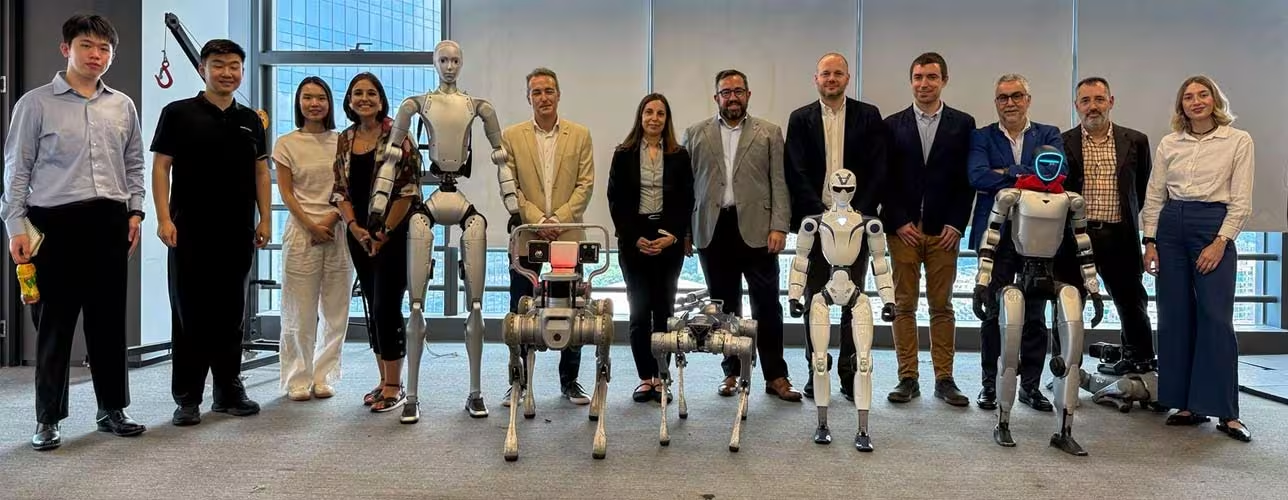
Navarra explores in Shenzhen new applications of AI, robotics, and advanced biotechnology that will shape the services and solutions of the future.
First Vice President and Minister of the Presidency and Equality, Javier Remírez, began a working agenda this Monday in Shenzhen (China) aimed at establishing links between Navarra’s technological and scientific capabilities and some international innovation ecosystems in fields such as Artificial Intelligence (AI), advanced robotics, and emerging technologies related to synthetic biology.
The purpose of these meetings is to identify collaboration opportunities that will help advance the real-world application of these technologies in strategic areas for the Autonomous Community, such as advanced industry, healthcare, education, public services, and social care, thereby strengthening Navarra’s position as an innovative and internationally connected region.
“The speed at which technologies such as AI, robotics, and biotechnology are evolving forces us to stay ahead. Navarra has a strong industrial base, research centers, talent, and technological infrastructures that allow us to actively participate in this transformation. However, in an increasingly connected world, cooperation with leading international knowledge hubs is essential,” Remírez emphasized.
He also noted that “innovation capacity does not depend solely on size, but on specialization, talent, and the ability to build synergies” between the Autonomous Community and the Asian country. “We are also here to share Navarra’s capabilities and to build connections that allow us to explore solutions with real impact on our economy, improve our public services, and ultimately enhance citizens’ quality of life,” he added.
Finally, the Vice President stressed that “Navarra’s goal is not only to be a recipient of new technologies, but to position itself as a territory where innovative solutions can be tested, validated, and implemented in collaboration with leading international partners.”
Accompanying Remírez are the Director-General for Science, Technology and Innovation, Agurtzane Martínez; the Managing Director of NASERTIC, Luis Campos; the coordinator of the IRIS Navarra Digital Innovation Hub, Ion Arrizabalaga; ICT specialist Juan Narro; and the Director of Personalized Medicine and Laboratories at NASERTIC, Gonzalo Ordóñez.
The delegation also includes professionals from the biomedical field linked to the Centre for Applied Medical Research (CIMA) at the University of Navarra, such as its Scientific Director, Antonio Pineda, and Therapeutic Innovation area member Inés Ibáñez.
Advanced robotics, AI, and talent
This first day of work focused on gaining first-hand insight into the latest developments in AI and advanced robotics, a continuously evolving field that is driving progress in how machines interact with their environment and with people.
The Navarra delegation held a meeting with UBTECH, a company specializing in humanoid robots and AI solutions, to discuss potential lines of collaboration. Navarra already uses technology from this company through the IRIS Navarra Hub, where it is applied in training, capacity-building, and technology outreach activities. The meeting also allowed exploration of new applications in other areas, with the aim of helping address challenges such as active ageing, personal autonomy, and the improvement of services.
The agenda also included a meeting with Unitree, a leading company in the development of autonomous robots and advanced robotic mobility systems. During this visit, participants explored cutting-edge technologies aimed at enhancing interaction between robots and their surroundings, which could boost applications in automation and assistance with complex tasks.
The delegation also met with representatives from Astribot and Engine AI, companies specializing in new generations of intelligent and humanoid robots. In this case, the technologies developed enable machines to better adapt to real-world scenarios, collaborating and interacting with people in different contexts.
In addition to these more technological and industrial meetings, the Navarra team visited the Qianhai Shenzhen-Hong Kong Youth Innovation Hub, a space designed to promote innovation, knowledge transfer, and international talent development.
For her part, Director-General for Science, Technology and Innovation Agurtzane Martínez highlighted that “Navarra has a highly specialized scientific and technological ecosystem, with recognized and accredited capabilities in health, biotechnology, AI, and advanced industry.” She added: “Innovation is also built by weaving international networks. Being present in ecosystems as large as Shenzhen helps us identify trends, establish connections with leading actors, and opens the door to new collaboration opportunities with Navarra’s R&D&I system.”
Upcoming meetings: synthetic biology and institutional engagement
The agenda will continue on Tuesday, focusing on synthetic biology and technology transfer. Among other visits, the Navarra delegation will tour the Shenzhen Synthetic Biology Infrastructure and the Guangming Laboratory of AI and Digital Economy, where a brief meeting with district authorities is scheduled in this city of nearly 18 million inhabitants. They will also learn about initiatives related to advanced manufacturing and 3D printing.
On June 24, the agenda will link with a business mission led by the Department of Industry and Business Ecological and Digital Transition, with the participation of Minister Mikel Irujo and a delegation of companies and entities from Navarra at the “Navarra–Longhua Forum on Innovation, Industry and Strategic Relations in the Greater Bay Area.”
This entire program is part of the actions driven by the Navarra International Plan (PIN), aimed at strengthening the international visibility of the Autonomous Community of Navarra in scientific and technological fields and fostering new partnerships.
Source: navarra.es


