Green light for four new places of memory, bringing Navarra close to 30 recognised sites
The Technical Coordination Commission on Historical Memory, which met today, has agreed to issue a favourable report to include four new Places of Memory in the regional network: the memorial of the Ferroviarios graves in Paternáin; the Irurita–Artesiaga road and the sculpture “Bidegabeko bidea” / “The Path of Injustice”; the monoliths dedicated to Vicente and Maravillas Lamberto in Ibiricu de Yerri; and the memorial space of the Casino in Andosilla. With these four additions, Navarra would have 28 places officially recognised under Foral Law. To these, the San Cristóbal Fortress (Ezkaba) is expected to be added shortly, within the framework of a protocol whose signature with the State is being finalised.
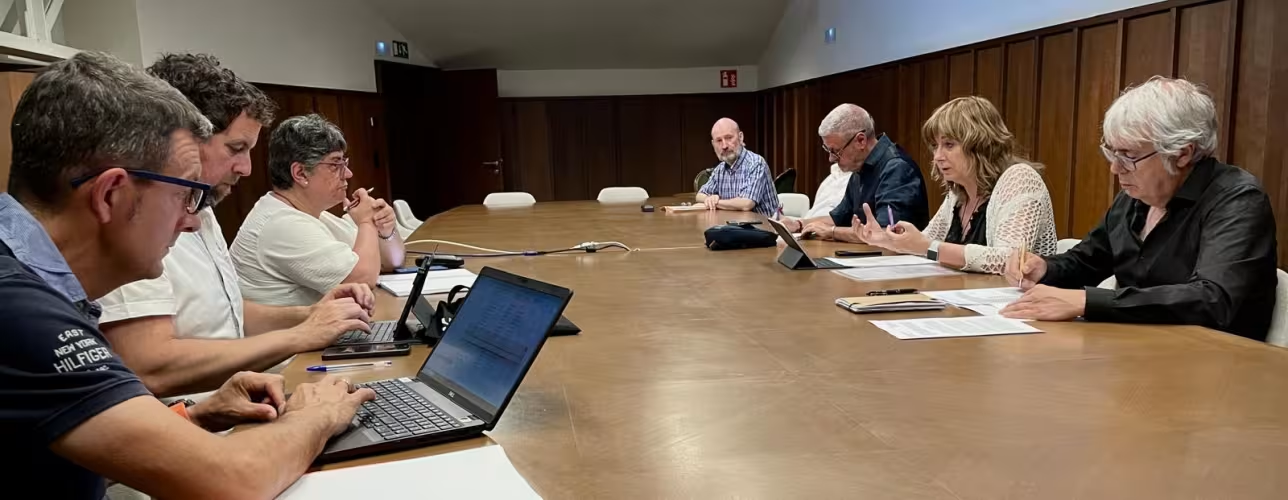
The Commission, chaired by the Vice President and Minister of Memory and Coexistence, External Action and Basque, Ana Ollo, adopted these agreements at the meeting held today at the Palacio de Navarra, where various matters related to Historical Memory in Navarra were also reviewed. These included the progress of the 2025 Exhumation Plan, identification processes and the programme of educational and awareness-raising activities.
In this first half of the year, the main indicators of the activity report of the Navarra Institute of Memory are as follows. Regarding the Public DNA Bank managed by Nasertic, there are currently 398 open cases, which have enabled the identification of 44 individuals. It should be recalled that at the recent meeting of the Territorial Council for Democratic Memory, Navarra offered the services of its DNA Bank to other autonomous communities through the State. As for exhumations, so far this year, the remains of two victims of repression have been located—one in Genevilla and another in Salinas de Oro / Jaitz. Prospectively work continues.
In the field of exhibitions, the most notable development is the recent opening of the exhibition “Beyond Mauthausen. Photographs by Francesc Boix,” held at the headquarters of the Mancomunidad de la Comarca de Pamplona (the former Salesas convent), the public inter-municipal authority responsible for services such as water supply, transport, and waste management in the Pamplona metropolitan área. The meeting also recalled that this year’s edition of the “Images with Memory” cycle brought together nearly 1,500 participants across its two venues, in Pamplona and Tudela. In the educational chapter (Schools with Memory), April saw the VII Intergenerational Meeting at the Sartaguda Memory Park; in May, the VII “Bottles of Freedom” march; and on 15 July a new edition of the “Route to Exile” will begin in Navarra.
During the period between the previous session of the Commission in March and today’s meeting, the new Pantheon at the Pamplona / Iruña Cemetery was also inaugurated (co-funded by the Government and Pamplona City Council), where the remains held in the previous pantheon and those stored by the Aranzadi Science Society have now been interred. Likewise, at the Buchenwald concentration camp (Weimar, Thuringia), two plaques were installed in memory of Navarrese victims of the Nazi Holocaust, next to a symbolic beech tree plantation carried out by students from several schools in the Comunidad Foral who travelled to Germany last April.
‘Places of Memory’ and the Network of Memory Spaces
To date, the map of Places of Memory (a category with higher protection than the Network of Memory Spaces) currently includes the following sites: the Sartaguda Memory Park; the Otsoportillo sinkhole (Urbasa); the Valcaldera corral (Cadreita); the Tejería grave in Monreal / Elo; the Alto de las Tres Cruces in Ibero; the Perdón graves; the Etxauri Memory Park; the Olave / Olabe graves; the GR-225 (San Cristóbal escape route and the “Bottles of Freedom” project); the Igal–Vidangoz NA-2130 road; the sculpture “Women Victims and Resisters,” in Peralta / Azkoien; the Argaitz quarry in Bera; the stele in memory of Germán Rodríguez and the sculpture “Gogoan” in Pamplona / Iruña (San Fermín 1978); the sculpture “Babesaren mugak” (The Boundaries of Protection) in Elizondo, Baztan; the Detention Centers Memorial (Pamplona / Iruña); the gate of Pamplona’s former prison; the Lodosa square; the Uroz Memorial Park in Lizoáin-Arriasgoiti; the sculpture “Por la Memoria” in Larraga; the Loiti Pass memorial (“Loiti, ixilpeko hilerria – Loiti, clandestine cemetery”); the monolith at the Vuelta del Castillo in Pamplona; the Legarrea sinkhole in Gaztelu; the Montejurra monolith in Ayegui; and the Oroibidea portal, one of the largest documentation repositories in Spain, which is recognised as a digital Place of Memory. To these, the four sites mentioned above will be added once approved by Government Agreement.
It should be recalled that Navarra is a pioneer in the official designation of Places of Memory, with its own specific law. Likewise, under State authority, the designation of the San Cristóbal Fortress as a Place of Memory is planned, a designation to be granted by the State under the National Democratic Memory Law—under the National Democratic Memory Law—within the framework of a broader protocol expected to be signed shortly with the Comunidad Foral.
Source: navarra.es


