Navarra offers its public DNA bank to help identify victims of the Franco regime
Navarra has offered its services to the Spanish government of its public DNA bank, managed by the public company Nasertic, to facilitate the identification of victims of Francoism from other regions that do not have these public resources. The Vice President and Minister of Memory and Coexistence, External Action and Basque, Ana Ollo, expressed this willingness to collaborate at the Territorial Council for Democratic Memory, held today and chaired by the Minister of Territorial Policy and Democratic Memory, Víctor Torres. The Council also discussed the allocation of funding for exhumations and other actions, according to which Navarra will receive 114,912 euros this year for exhumations and other initiatives related to the recognition of victims of Francoism or the dissemination of democratic values.
Navarra (the Comunidad Foral) highlighted its progress and commitment in various areas, such as the Places of Memory (the San Cristóbal Fortress will soon receive this designation thanks to an agreement with the State); the identification of victims of Francoism and the dictatorship through DNA; and the need to maintain updated registries of Francoist symbols.
Almost Fifty Identifications Thanks to Genetic Samples
Navarra is the first region to have, at a governmental level and thanks to the collaboration of the public company Nasertic, a public DNA data bank enabling genetic sequencing to identify human remains recovered during exhumations. The bank, which currently has 398 open cases, has so far enabled 43 identifications. Although the formal mechanism for coordinating this collaboration through the State Secretariat is still being defined, Navarra has long-standing experience in this field and has achieved significant results. These could be further strengthened through inter-regional cooperation and advances in genetic techniques, which now allow for more detailed analysis even from samples provided by relatives several generations removed. Nasertic is also one of the thirteen laboratories accredited at the national level.
In her remarks, the Vice President highlighted this tool, which began operating in 2016 within the framework of public memory policies, while reiterating Navarra’s willingness to collaborate by sharing information and advancing in these identifications—something already being done with other regions such as the Basque Country and Catalonia through broader agreements. Ollo recalled that the use of artificial intelligence in various databases related to this period is also being explored—an area in which Navarra is a reference thanks to Oroibidea, which compiles documents and other materials concerning more than 23,000 people.
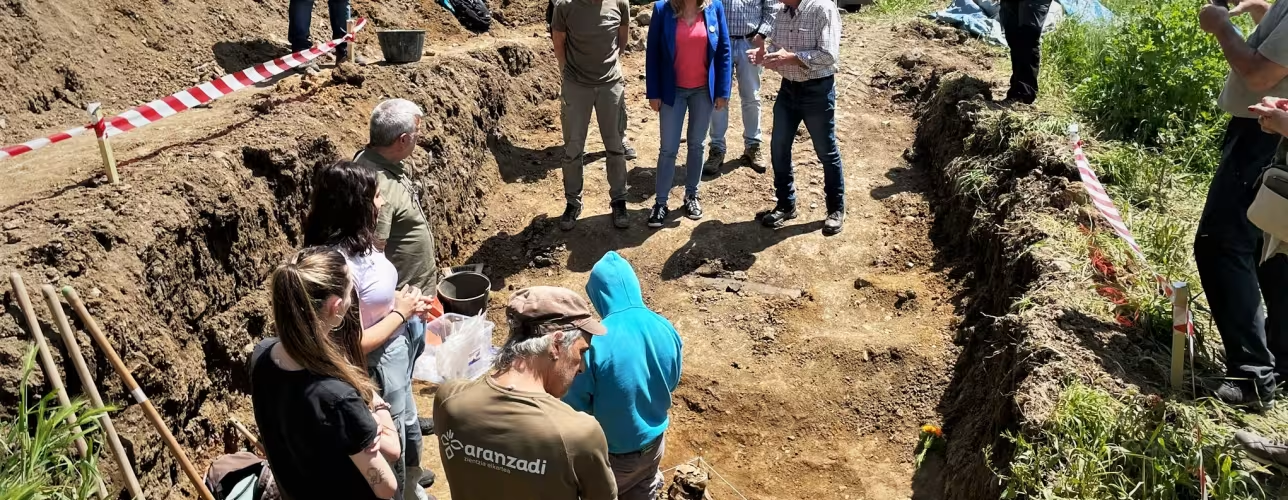
At the Territorial Council for Democratic Memory, the criteria for the distribution of funding for democratic memory initiatives were also approved under national budgets and regulations. In the case of Navarra, these funds will be used, among other purposes, to reinforce the annual exhumation plan carried out in collaboration with memorialist associations, which has so far enabled the recovery of 158 bodies across 34 exhumations, as well as 121 additional surveys that did not result in an exhumation. These funds (which will amount to 114,912 euros for Navarra) are also expected to support initiatives related to raising awareness about the legacy of the dictatorship and recognizing victims.
Source: navarra.es


