Collaboration between the Government of Navarra and the Pamplona city council makes it possible for the San José Municipal Cemetery to now have a new pantheon for the victims of francoism
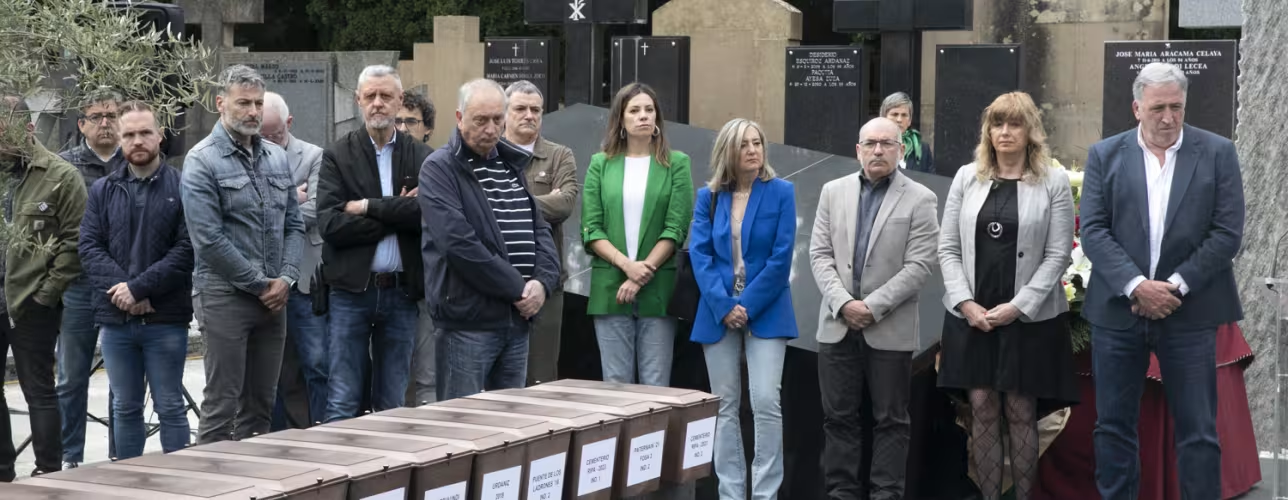
The Municipal Cemetery of Pamplona / Iruña now has a new mausoleum that will house victims of Francoism, a project made possible thanks to institutional collaboration between the Government of Navarra and Pamplona City Council. The Vice President of the Government of Navarra and Minister of Memory and Coexistence, External Action and Basque, Ana Ollo Hualde, and the Mayor of Pamplona, Joseba Asiron Saez, presided today over the inauguration of this new space together with associations and families who, led by the Vice President of the Association of Relatives of Those Shot in Navarra (Affna 36), Eneko Arteta Oronoz, also took part in a symbolic burial ceremony for the remains of 15 people murdered after 1936.
This ceremony officially marks the beginning of new burials in the expanded mausoleum, a task undertaken by Pamplona City Council after the previous facility, built in 2013 and also municipally owned, reached full capacity. The intervention, with a budget of 278,106 euros, received a contribution of 125,000 euros from the Government of Navarra.
Vice President Ana Ollo, accompanied by both the Director General of Memory and Coexistence, Martín Zabalza, and the team of the Navarra Institute of Memory, framed the event within “a sustained commitment through public policies of historical memory, one of whose pillars is the search, recovery and identification of the victims of Francoism. I would like to recall that the public DNA Bank managed by Nasertic currently has 398 active cases files currently being processed. This commitment goes further, since in the current times it symbolically reinforces the importance of recovering memory to build a future of peace and coexistence in the face of new authoritarian threats.”
For his part, the Mayor of Pamplona, Joseba Asiron, emphasized that the expansion of this facility “was a moral debt, a democratic necessity” not only toward victims of Francoism, but also toward “those who refused to accept silence and demanded justice for their relatives,” because “it is not only about burying with dignity, but about restoring dignity to their memory of these people.”
After the speeches, members of memory associations placed 15 boxes inside the mausoleum containing the remains of unidentified individuals murdered by the Franco regime.
These are the first of many more, as the new mausoleum has capacity for nearly 300 boxes, which means approximately quadrupling the previous capacity (60 boxes). During the event, Vice President Ollo and Mayor Asiron placed floral arrangements on the black‑granite‑covered polyhedrons embedded in the landscaped ground that decorate the mausoleum. The ceremony featured musical pieces including Adagio by Tomaso Albinoni and Aria from the Suite in D by Johann Sebastian Bach, performed by the Zura Quartet (violins: Daniel Sadaba and Leire Fernández; cello: Paula Azcona).
A Space for Recognition and Reparation
The existence of a space for recognition and remembrance, such as the mausoleum in the San José Municipal Cemetery in Pamplona, is a long‑standing demand of memorialist associations, as well as a requirement under Foral Law 33/2013, of 26 November, on the recognition and moral reparation of Navarrese citizens murdered and victims of repression following the 1936 military coup. The previous mausoleum was built in 2013 with capacity for up to 60 boxes; the new one has a larger capacity (135 m²) for around 380 boxes, and is presided over by a large rectangular granite monolith.
The mausoleum is open to different types of victims. On the one hand, it may house the human remains of Civil War or Francoist victims who disappeared and were exhumed in accordance with Foral regulations, as well as victims whose remains were found in a grave in Navarra but could not be identified.
It may also house the remains of individuals found in a grave in Navarra who, although identified, could not be returned to their families or whose families were unable to take responsibility for them. In addition, it may receive the remains of Pamplona residents who were executed, identified and whose families request burial in the pantheon. Finally, this space may also host the remains of Navarrese victims found in graves in other parts of Spain who, despite being identified, could not be returned to their relatives or whose families were unable to take responsibility for them.
Source: navarra.es


