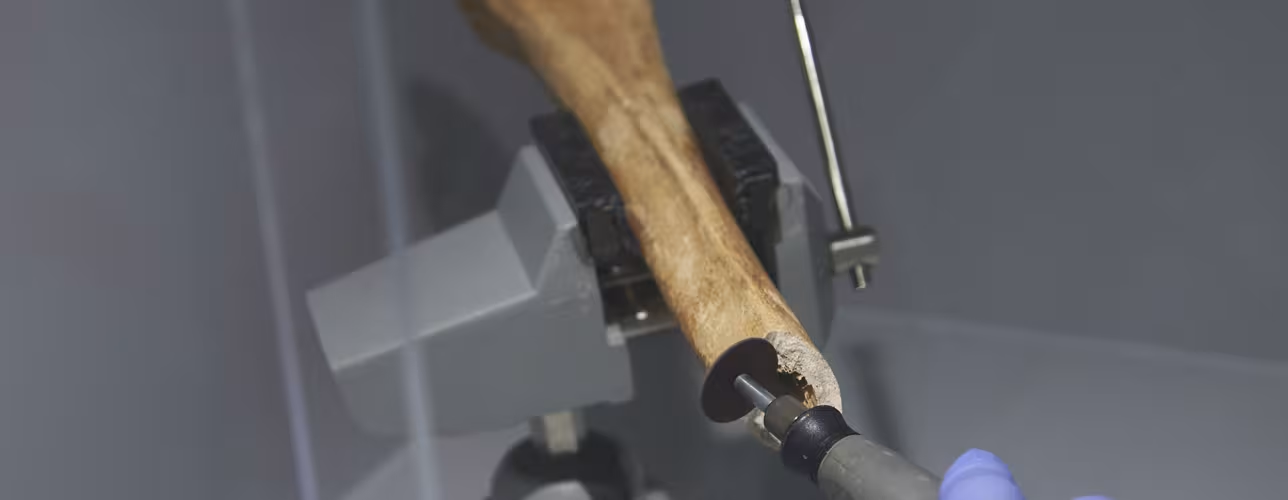
The Navarra Institute of Memory manages to identify, thanks to the work of the DNA Bank, 30% of the bodies of victims of francoism recovered since 2015
The Government of Navarra, through the Department of Memory and Coexistence, External Action and Basque, has just published the revised and updated version of the book “Bajo Tierra. Exhumaciones en Navarra 1939–2025. Lur Azpian. Desobiratzeak Nafarroan 1939–2025,” which recounts the history of the exhumations of the victims of Francoism in Navarra in different phases from 1939 to the present day—a field in which both civil society and Navarra’s institutions have been pioneers nationwide.
The launch in 2016 of the Exhumations Programme by the Navarra Institute of Memory—working with memorialist associations and through agreements with the Aranzadi Science Society and the involvement of NASERTIC— gave new impetus to and helped systematise the search for, exhumation and identification of the remains of the 3,526 people murdered and who died in captivity in Navarra after the 1936 coup and during the dictatorship. In fact, over the past decade, the Government of Navarra has managed to identify, via the public DNA Bank, 30% of the bodies of victims of Francoism that it recovers thanks to the work of the Navarra Institute of Memory, which has a map of 269 graves as well as an extensive documentary archive on Oroibidea.
Overviewof the Exhumations Plan Over the Past 10 Years
According to the latest balance of Navarra’s Exhumations Plan, since 2016 there have been 166 operations, of which 38 have been successful. In these 38 graves, the remains of a total of 163 people have been recovered, among whom 47 have been identified. According to some estimates, there are still around 850 people in Navarra yet to be found, and the passage of time and the disappearance of witnesses make their location more difficult. Despite this, advances in technologies such as those related to genetic identification are proving decisive, since they make it possible to identify—i.e., determine the identity of the exhumed remains—in almost 30% of cases.
The Navarra DNA Bank, managed by the public company NASERTIC, has 418 open cases thanks to samples provided by families searching for their missing relatives. These samples have been decisive in identifying recently exhumed and publicly identified remains, such as those of Ramón Bengaray, who was president of the Popular Front in Navarra, or those currently being identified in the Berriozar grave, among them an anarchist of U.S. nationality, Ignacio Francisco Caneda, among others.
It is also worth noting that the Oroibidea documentation centre, with references to nearly 25,000 victims of Francoism, has a specific section on exhumations, and it is possible to contact the Navarra Institute of Memory at any time via its email address, inm@navarra.es, for those who may have information relating to these people, who know the locations of graves or burials, or who wish to share their testimony.
A Collective Volume
The reissued book goes back in time to reflect—with abundant graphic and testimonial documentation—the different phases of this process, which is fundamental to the recovery of historical memory and usually links the tasks of documentation with those of survey work, exhumation and identification. This chain of actions concludes with the formal handover of the remains of victims of repression to their families—an act that, in the case of the latest identifications, will take place at the beginning of the year.
“Bajo Tierra. Exhumaciones en Navarra. 1939–2025 – Lur Azpian. Desobiratzeak Nafarroan. 1939–2025” is a collective work compiling the memorialist actions carried out in the Comunidad Foral from the end of the civil war to the present day. It is now available to the public from the Government of Navarra’s Publications Fund, priced at 20 euros, and in the coming days it will be available for purchase in bookstores.
The publication has been coordinated by members of the Navarra Institute of Memory—José Miguel Gastón, Manuel Ibáñez and César Layana—and edited by the Government of Navarra. It is structured into three distinct yet interconnected parts, demonstrating the commitment that began as soon as the civil war ended and has remained firm to this day. The exhumation process was initiated by families themselves—especially intensely between 1978 and 1980; it was continued by associations of relatives from 2003; and the Government of Navarra took up the baton in 2015, driven by their determination.
The first part, written by researcher Jimi Jiménez, focuses on the so‑called early exhumations, carried out from the early post‑war years until the Transition. The second part covers the early 21st‑century reactivation of pending exhumations, driven by various associations—especially AFFNA36, but also Txinparta and Memoriaren Bideak, among others—as well as some town councils such as those of Bera, Berriozar and Egüés. The third part addresses the Exhumations Plan promoted by the Government of Navarra since 2016. This plan is implemented via an annual agreement signed with the Aranzadi Science Society and is one of the strategic pillars of the Government of Navarra’s public memory policies, which have also established synergies in this area with the State and other autonomous communities such as Euskadi and Catalonia.
Finally, it should be noted that in the second and third sections of the publication, the analysis of exhumations is organised around data sheets, prepared by researchers and anthropologists Lourdes Herrasti and Francisco Etxeberria, which compile the historical information, explain the exhumation process and, where applicable, the identifications carried out, as well as including the testimony of participants, accompanied by extensive graphic and photographic support.
Source: navarra.es


