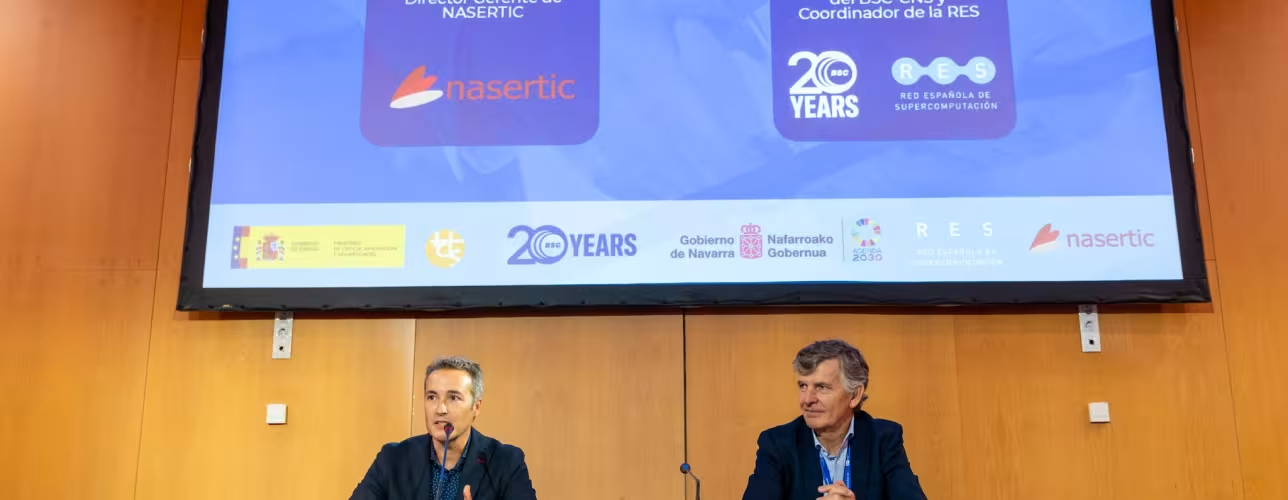
Navarra Hosts the 19th Annual User Conference of the Spanish Supercomputing Network
Navarra is hosting the 19th session of the Annual User Conference of the Spanish Supercomputing Network (RES), JURES 2025. The public company NASERTIC, attached to the Department of Presidency and Equality, participates in this Network through the Urederra Cluster and is the host of this edition, which is bringing together more than 150 specialists and RES users at the Navarra Conference and Auditorium Centre (Baluarte), in Pamplona / Iruña.
Talks and round tables on Artificial Intelligence, Deep Learning, green science and sustainability, as well as science outreach in seminars and workshops, form the core of the programme, whose purpose is to provide attendees with updates on developments within the RES and offer relevant information on access to its resources and to the European HPC (High Performance Computing) ecosystem.
At this morning’s opening session, Garbiñe Basterra, Director General of Energy Transition and Digital Transition and Business R&D&I and Entrepreneurship, took part, noting that for Navarra “joining the RES has been a turning point for accelerating research, development and innovation throughout Navarra’s innovation ecosystem, integrating companies, technology centres and universities—key elements for the dual transition driven by the Department of Industry and Ecological and Business Digital Transition.”
In his opening remarks at JURES, José Ignacio Doncel, Deputy Director General for Large Scientific-Technical Facilities at the Ministry of Science, Innovation and Universities and President of the RES Council, noted that “the MICIU maintains its support and confidence in an infrastructure that serves the Spanish scientific community. Thanks to collaboration between entities dependent on the General State Administration and regional governments, and to funding mechanisms for major Unique scientific-technical infrastructures (ICTS), we can combine capacities and expand the geographical coverage of the RES, reinforcing our technological competitiveness.”
Finally, Sergi Girona, Director of Operations at the Barcelona Supercomputing Center – National Supercomputing Center (BSC-CNS) and Coordinator of the RES, highlighted: “Navarra—with the Urederra Cluster and the commitment of NASERTIC—is a good example of how the contribution of local talent and capabilities strengthens the entire RES and translates into concrete advances in research. Our challenge in the coming years is to continue expanding this ecosystem to offer locally accessible supercomputing resources and, under the coordination of the BSC, consolidate the RES as a key tool to address major scientific and social challenges.”
In this context, this will be underscored tomorrow at the official closing by Luis Campos, Managing Director of NASERTIC, who has already noted that “thanks to the RES, Navarra has been part of the national ICTS Map since 2022, and that the sharing of specialised talent—demonstrated over these three days among the 14 nodes—has helped Navarra advance and position itself at the technological forefront thanks to this collaborative and innovative network model.”
Three days of activity
This supercomputing event began yesterday morning with an open and participatory talk for students on “The Impact of AI on Our Professional Future: From Training to the Workplace.” In the afternoon, two technical workshops were held: one on running jobs in Slurm and another on cooling and energy consumption.
One of the most anticipated moments of the event is the presentation of the RES-HPC Award, the highest supercomputing prize granted in Spain, which will be awarded during tonight’s dinner hosted at the Refectory of the Pamplona Cathedral. This year, the RES-HPC Award has gone to Humberto Bustince, Professor of Computer Science and Artificial Intelligence at the Public University of Navarra, Honorary Professor at the University of Nottingham, and member of the Smart Cities, Navarrabiomed and IDISNA (Navarra Institute for Health Research) research institutes.
Lastly, tomorrow the event will conclude with a morning session reviewing the actions carried out by the RES during the past year and presenting the results of the RES User Committee, through its president, José Javier Plata. A final round table on green science and sustainability will close the technical programme.
Additionally, throughout the sessions, several awards will be presented, including the prizes for the best posters and reviews of 2025.
The RES
The Spanish Supercomputing Network (RES) is made up of 14 nodes and coordinated by the Barcelona Supercomputing Center – National Supercomputing Center (BSC-CNS).
The RES manages high-performance computing, data analytics and Artificial Intelligence resources with the aim of driving scientific and innovation progress in Spain.
To achieve this goal, the RES offers its resources through an open, common and competitive access system. The application process is the same for all RES nodes and is based on criteria of effectiveness, efficiency and transparency. This common access guarantees optimal use of all the resources available in the network (computing, storage, parallelisation, etc.).
In addition, the RES promotes actions of common interest for its nodes, such as investment plans, training and outreach activities, and joint participation in national and international projects.
Source: navarra.es
