IRIS EDIH has provided 500 digitalization services to 100 companies between 2023 and 2025
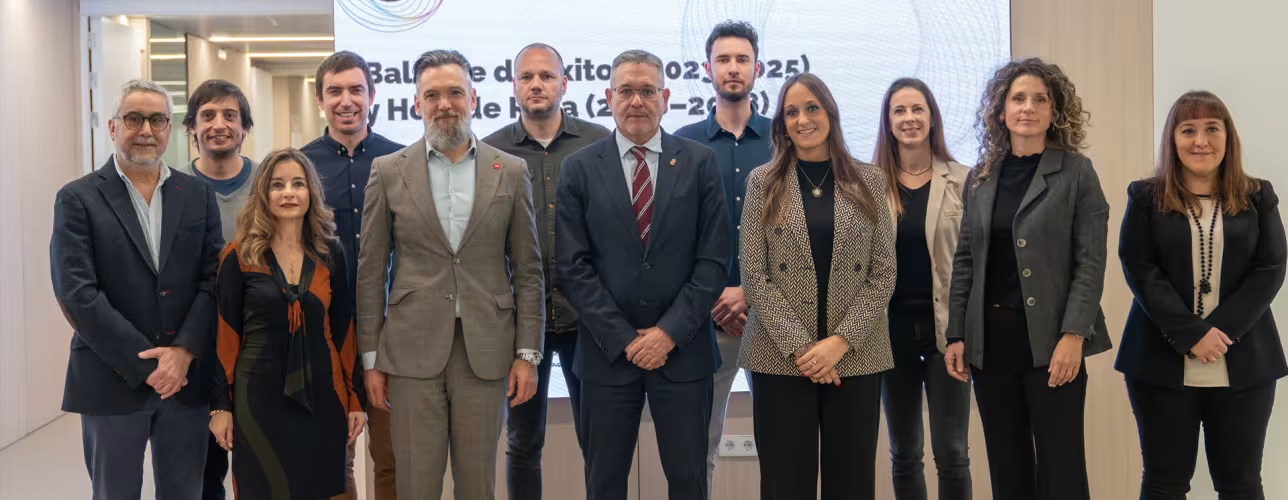
An event was held this morning as part of the European IRIS EDIH project of Navarra’s Digital Innovation Hub (IRIS), where the results achieved in the period between 2023 and 2025 were presented, along with the roadmap for the next period between 2026 and 2028.
The event began with remarks by the Minister of University, Innovation and Digital Transformation, Juan Luis García, who highlighted that “in just three years, IRIS EDIH has shown that Navarra not only talks about innovation but puts it into practice. This Hub has consolidated itself as a true digital engine, capable of anticipating, connecting and opening up new opportunities for our companies and administrations.” He also stressed that “this progress has been possible thanks to a solid innovative ecosystem, the support of the Digital Europe Programme and the Ministry of Industry and Tourism, and the coordinated work led by ADItech in strategic areas such as artificial intelligence, supercomputing and personalised precision medicine.”
He also recalled that these advances are taking place in a particularly positive context for the Comunidad Foral: “Navarra is recognised as a strong innovator region, one of eleven regions of excellence in Europe, and we lead the country in R&D investment.” In the Minister’s words, these figures confirm that “innovation is not a discourse but a political decision and a strategic priority of this Government.” He therefore thanked all the entities involved and reaffirmed the will to continue driving a Navarra “that is more innovative, digital and competitive, advancing without losing ambition and without setting limits to its future.”
After his remarks, a round table took place in which Andrea Urrecho, Head of Digital Innovation at ADItech and coordinator of the IRIS EDIH project, reviewed the main results. Among them, she highlighted not only the number of services provided and the opportunity they represented for advancing companies’ digitalisation, but also the opportunity to connect with other territories of the European Union that, like Navarra, have been designated as EDIHs (European Digital Innovation Hubs). EDIHs, Urrecho recalled, are considered a key instrument for Europe’s digitalisation, especially SMEs. In total, IRIS EDIH has enabled the creation of 24 alliances—8 at the national level and 16 at the European level. Following her remarks, Nancy Tarjenian of AIN and Mikel Hernáez of the University of Navarra— both project partners—reviewed the services delivered. To conclude this panel, Eduard Melnicenco, Project Technician at ADItech, mentioned the satisfaction level achieved by the companies that benefited from those services.
After this recap, it was time to hear some of the success stories achieved during the project’s first years thanks to services provided by partner entities. Fernando Varela of the company Materialight presented the first success story, thanks to the service for producing prototypes in additive manufacturing and ad hoc series provided by Dinabide. Carolina Elduyacen of the company CYC presented her case, thanks to the service for diagnosing software engineering processes and managing their life cycle provided by Tracasa Instrumental. Diego Mendiola of the company Caviar Pirinea mentioned the results after receiving a service on diagnosis and proofs of concept for the use of portable NIR technology to determine properties related to the quality and food safety of trout fillets, provided by CNTA. Anna Duarri of the Vall d’Hebron Institute shared her experience thanks to the service on computational analysis of RNA‑seq data and pre‑processing provided by the University of Navarra. Ismael Ezquier of Prosimed spoke about the service provided by AIN on initial advice and implementation of a data structure. Lastly, Deyan Yavorv of Genbioma explained the genomic sequencing services provided by NASERTIC.
After this first phase, new services to be offered within the IRIS EDIH environment were presented, as well as the IRIS Lab equipment now available to companies and public entities. Specifically, the new services were presented by: Francisco Falcone of UPNA, as lead for the services for connected, secure and intelligent elements; Ángela Bernardini of NAIR Center, as lead for the data science and artificial intelligence services group; Mayu Serreau of Dinabide, as lead for the functional or additive printing services group; Antonio Pineda of CIMA, as lead for the synthetic biology services group; and Gonzalo Ordóñez of NASERTIC, as representative of the personalised and precision medicine services group.
The event was closed by the Minister of Industry and Ecological and Business Digital Transition, Mikel Irujo, who highlighted the IRIS EDIH service figures, noting that this represents “a demonstration that this project offers potential and quality services to our business and industrial fabric.” “It likewise offers collaboration to emerging sectors of our economy with strong growth, such as synthetic biology, the industrialisation of construction or electronics. We face a broad field of work that can help us in the digital transition, which is unstoppable,” he underlined.
In this regard, Irujo stressed that “when properly applied and understood, digitalisation is already a driver of competitiveness for our companies.” “This is why it is so important to have tools and training; it is key to have resources like those offered by the Digital Innovation Hub. As I said before, this transition is unstoppable, and these services will undoubtedly continue to grow,” he concluded.
The event also featured the participation of Diego Garrido, Director of ADItech—the entity that coordinates SINAI, the Navarra R&D&I System, and is responsible for coordinating the IRIS EDIH project—who highlighted the importance of these initiatives in fostering the progress of Navarrese companies.
Source: navarra.es


