The Government of Navarra launches a pioneering cybersecurity education programme for children
The Government of Navarra, through the Department of Education and the public company Nasertic, attached to the Department of Presidency and Equality, has signed a cooperation agreement to develop an innovative cybersecurity education programme aimed at children and adolescents.
The agreement seeks to strengthen students’ digital skills and ensure critical and safe technological literacy adapted to the challenges of the digital environment, while also promoting an understanding of the scope of the digital footprint and its relationship to digital identity and reputation.
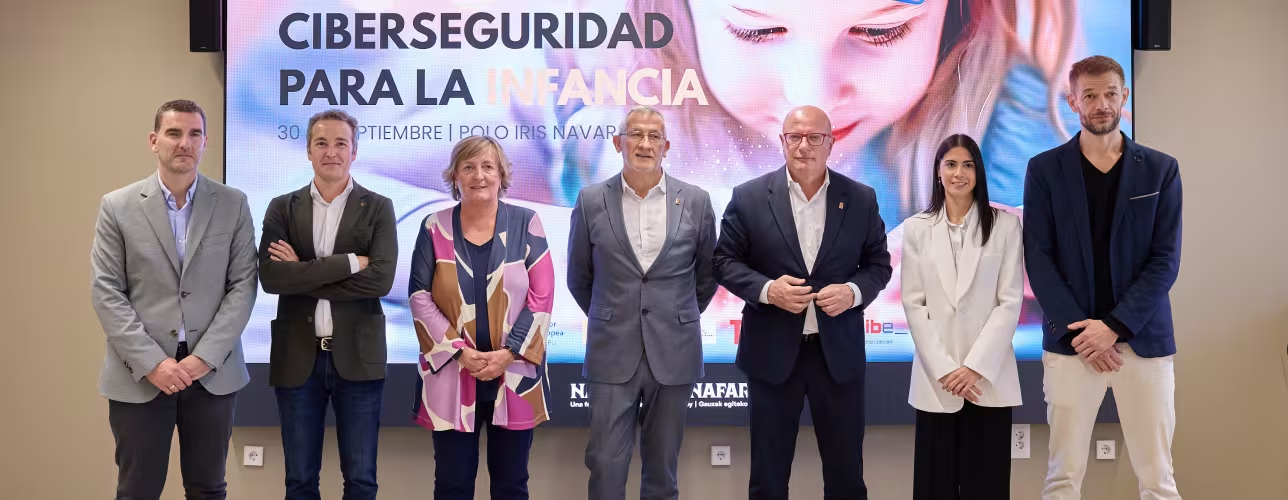
The institutional event took place at the IRIS Digital Innovation Hub, with the participation of the First Vice President and Minister of Presidency and Equality, Félix Taberna, and the Minister of Education, Carlos Gimeno. The agreement was signed by Luis Calatayud, Director General of Digitalisation and Educational Services, and Luis Campos, Managing Director of Nasertic.
Vice President Taberna stated: “Machado wrote in one of his most famous poems: ‘Traveller, your footsteps are the path, and nothing more.’ Today, this verse takes on a new meaning in the digital world, where we also leave footprints. But unlike those evoked by the poet, these footprints do not fade: they remain stored on servers and embedded in algorithms, open to interpretation and use. For this reason, it is essential that, from the classroom, we educate critical, free and digitally aware citizens.”
For his part, Minister Gimeno highlighted that “with this agreement, Navarra strengthens its leadership in digital education policy development, committing to an approach that links technological innovation with inclusion, equity and the protection of children.”
Content of the Cybersecurity Programme
The initiative aims to design a training programme that incorporates specific cybersecurity concepts to encourage the responsible, ethical and critical use of technology from an early age. Educational materials and resources will be developed for both students and teachers, including certified training for educators. The programme is aimed at pupils from first to sixth grade of Primary Education, aged between 6 and 12.
This agreement is part of the digital education transformation strategy driven by the Department of Education, specifically within the ikasNOVA Plan, and is based on the content of the CODI programme (Digital Skills for Childhood).
In this context, the course to be implemented aims to deploy a training programme on positive behaviour and conscious use of the digital world, aimed at students, teachers and families, with the goal of integrating it into the Government of Navarra’s education network during the 2025 / 2026 academic year.
The project will be implemented in a number of pilot schools designated by the Department of Education to facilitate its integration into the ikasNOVA Digital Education Plan.
The content is structured into several thematic blocks addressing key aspects for safe and responsible online interaction, such as digital footprint awareness, image and privacy management online, detection and prevention of fake profiles and illegal or inappropriate content, as well as the identification of digital aggression from “haters,” “trolls” or bullies.
The programme also includes a module aimed at promoting values of empathy, respect and collective responsibility in digital environments, fostering the socio-emotional skills needed for positive interaction. It also emphasises the importance of balanced use of screens and devices, particularly regarding video games and social media, introducing strategies for self-regulation and healthy digital consumption habits.
This comprehensive approach aims to provide the education community with methodological tools and pedagogical resources that strengthen students’ digital skills, consolidate critical and responsible attitudes in the digital ecosystem and ultimately contribute to building a safer, more inclusive and more more responsible digital environment.
Structure and Commitments of the Agreement
Under the agreement, the Department of Education will coordinate the project, define the pedagogical content and retain ownership of the training materials developed. It will also integrate the programme into the Teacher Training Plan and promote its implementation in publicly funded schools in the Comunidad Foral.
Nasertic, through the Navarra Cybersecurity Center (NavCC), will provide the funding needed to create content and will ensure technical quality in cybersecurity, complying with international standards and best practices.
The Navarra Cybersecurity Center is part of the RETECH programme (Territorial Networks for Technological Specialisation), promoted by the Secretariat of State for Telecommunications and Digital Infrastructure, coordinated by INCIBE and funded under the Recovery, Transformation and Resilience Plan (Next Generation EU). The €220,000 for this project will be funded from these funds.
Governance Mechanisms and Duration
The agreement establishes a Monitoring Committee made up of technical representatives from both entities. This committee will supervise the project’s implementation, assess its impact and address any issues that may arise, allowing technical or management adjustments through recorded agreements.
The agreement will remain in force until 31 December 2025, with the possibility of extension for up to four additional years, and does not entail financial commitments for the Department of Education.
An Approach Aligned with the European Context
The European Union considers cybersecurity an essential pillar of digital transformation. In the EU Cybersecurity Strategy for the Digital Decade (2020), the European Commission and the High Representative stressed that digital resilience must be built “by and for citizens,” strengthening young people’s capacity to respond to digital risks.
Likewise, the Digital Compass 2030 sets the goal that by the end of this decade at least 80% of Europe’s population will have basic digital skills, including knowledge of digital security.
In the field of education, the Digital Education Action Plan 2021–2027 urges Member States to integrate digital safety and critical thinking content into school curricula to prepare young people to face challenges such as cyberbullying, disinformation or data theft.
In Navarra, this programme connects directly with those European priorities: it reinforces the digital literacy of children and adolescents and responds to the commitment to build a safer and more resilient Europe in the face of technological challenges.
Influence of Technology on Children and Adolescents
It is worth recalling that officers from the Cybercrime Unit of the Policía Foral conducted a study on the influence of technology on 1,930 fifth- and sixth-grade students (aged 10 to 12) from 26 schools across Navarra.
The report shows the growing impact of technology at this stage of life, as 60.5% have a mobile phone with Internet access, with hardly any adult supervision. Eighty-seven percent use social platforms such as YouTube, WhatsApp or TikTok to have fun (63% of respondents) or socialise with friends (40%).
Another important finding is that nearly 13% of minors accept unknown people online, although 96% never meet them in person. Exposure to pornography is occasional (2.6%), and the grooming of minors for sexual purposes online is confirmed as a concerning indicator, with nearly 3% reporting having received sexual propositions.
Additionally, 6.5% of respondents report having been victims of cyberbullying at some point, compared with 2.3% who admit to having perpetrated such behaviour. Ninety-four percent indicate they have never engaged in inappropriate behaviour online, while 6% acknowledge having done so at least once.
Source: navarra.es


