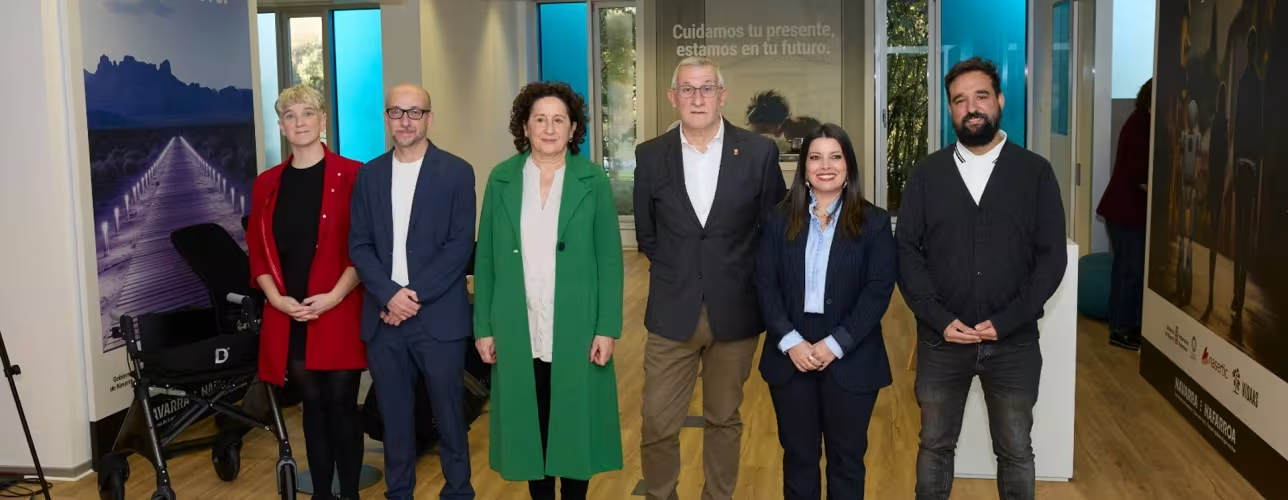
Vice President Taberna and Councillor Maeztu Inaugurate VIDAAS, the New Centre Where Technology and Social Innovation Converge to Transform Lives
The VIDAAS Centre—an acronym for Vanguard and Innovation for Active, Autonomous and Healthy Development—opened its physical headquarters this morning in Sarriguren with a gathering that brought together nearly 60 representatives from the institutional, academic, business, third‑sector and technology‑centre spheres. The event reaffirms Navarra’s commitment to placing social innovation at the service of the common good, aimed at building a society with higher levels of well‑being and quality of life.
Promoted by the Department of Presidency and Equality through the public company NASERTIC, the VIDAAS Centre has 800 square metres dedicated to the real‑world testing and development of new solutions designed to improve people’s autonomy, health and quality of life. The facilities include a large co‑working space, three experimentation rooms, a training room and two meeting rooms, all open to the social innovation ecosystem. The centre is fully accessible and has the necessary elements and conditions (access, spatial layout and signage) to guarantee inclusion and safety for all users.
“We are not just inaugurating a building; we are inaugurating a way of thinking and cooperating so that things happen,” emphasised the First Vice President and Minister of Presidency and Equality, Félix Taberna. He recalled that “Navarra has always been an innovative territory” and highlighted that, on this occasion, it is now innovating in the social sphere.
“The VIDAAS Centre is a meeting point between the technological vision and the human perspective of public policies, because true public innovation is born when we combine technical knowledge with empathy,” he noted.
The Councillor for Social Rights, Social Economy and Employment, Carmen Maeztu, stated that the VIDAAS Centre aspires to be a space where “collective responses are born to the great challenges of our time: ageing, digitalisation, sustainability and equity.” “In Navarra, innovation has a social soul. VIDAAS is the meeting point between intelligence, participation and collective commitment,” she concluded, underscoring the solidarity‑driven and transformative character that defines the Comunidad Foral.
Opening day programme
The event began with words of welcome from Xuriñe Peñas, Mayor of the Valle de Egüés / Eguesibar, followed by opening remarks from Vice President Taberna. Raúl Oliván, Director of Fundación Hexagonal, then took the floor.
Messages were later screened from several leading figures in social innovation at the national level. Speakers included Juan Cruz Cigudosa, Secretary of State for Science, Innovation and Universities; Patricia Bezunartea, Director General for Family Diversity and Social Services; and Pablo Sánchez, founder and director of the NGO Medicina Abierta al Mundo and Princess of Girona Social Award 2025.
The day also featured the panel discussion “VIDAAS for Everyone,” bringing together voices from Navarra’s social, academic, business, scientific and institutional spheres. The panel included Aitziber Aldabe Moreno, Academic Coordinator at UNED Pamplona / Iruña; Carlos Fernández, Secretary General of the Navarra Business Confederation (CEN); Héctor Barbarin, Director General of the National Centre for Food Technology and Safety (CNTA); Mari Luz Sanz, President of the Committee of Entities Representing People with Disabilities of Navarra (CERMIN); and Txerra García de Eulate, Director General of Planning, Coordination, Innovation and Evaluation of Public Policies. The conversation, moderated by the centre’s coordinator, Idoia Urmeneta, concluded with institutional remarks by Councillor Maeztu. Among the audience were also Luis Campos, Managing Director of NASERTIC; Rubén Auza, Managing Director of the Office of Analysis and Foresight; and Jesús Mari Rodríguez, Director General of Local Administration and Depopulation.
After the institutional segment, attendees toured the technology “showroom,” an interactive space showcasing various innovative solutions developed in collaboration with companies, universities and social entities. Visitors were able to try, among other devices, smart walkers designed to prevent falls and an induction cooktop adapted for people with disabilities. The functioning of a seal‑shaped personal assistance robot—designed to interact empathetically with users and already in use in hospitals and care homes—was also demonstrated. In addition, attendees had the opportunity to experiment with AI‑enabled glasses.
At the service of Navarra’s social innovation ecosystem
The VIDAAS Centre is open to the entire social innovation ecosystem in Navarra. The technology “showroom,” equipped to test inclusive technologies, is one of the centre’s most notable services: a real‑world experimentation space where solutions aimed at well‑being and quality of life are put to the test.
The centre also deploys other lines of action, including organising workshops aimed at identifying significant challenges and formulating responses in an agile and collaborative manner. It likewise hosts meetings for the exchange of applied knowledge in the fields of social and technological innovation.
VIDAAS also promotes comprehensive project management and the facilitation of groups to capture needs and foster the participation of end users in the development of new solutions. Its functions include preparing documents, reports and outreach materials in Easy‑to‑Read format and in several languages, with the aim of raising awareness and making information accessible to the whole population.
Thus, the VIDAAS Centre leads, manages and participates in joint initiatives and projects at the regional, national and European levels, acting as a channel for talent in social innovation, integrating research and development, and promoting solutions that help improve people’s well‑being and quality of life.
Solutions already being driven by VIDAAS
Recently, UMANA was presented, a project aimed at promoting the employment inclusion of people with intellectual disabilities in the technology sector. The initiative, promoted by the Department of Presidency and Equality of the Government of Navarra through the VIDAAS Centre, is being developed as a public‑private collaboration with Fundación “la Caixa,” Fundación TeReSA and with the participation of Fundación Hiberus. The programme aims to generate real employment opportunities in digital and technological environments, strengthening skills and social integration through specific training and ongoing support in the labour market integration process.
The AI Mobility – tu ruta – project is about to conclude. This initiative emerged from a challenge identified in the discovery sessions of the Retos IA programme, organised by the Department of Presidency and Equality through the VIDAAS Centre, the NAIR Center and ATANA. As a result of this process, AI Mobility is working on the design of an accessible app simulator for the Pamplona metropolitan urban transport system, aimed at improving users’ autonomy and safety.
In addition, since last year ten third‑sector entities have benefited from the loan of virtual‑reality glasses intended for cognitive stimulation, physical activation and well‑being, with satisfaction levels reaching 4.8 out of 5 after use in their own facilities. A similar loan has also recently been launched to test smart walkers equipped with artificial intelligence to prevent falls.
Source: navarra.es


