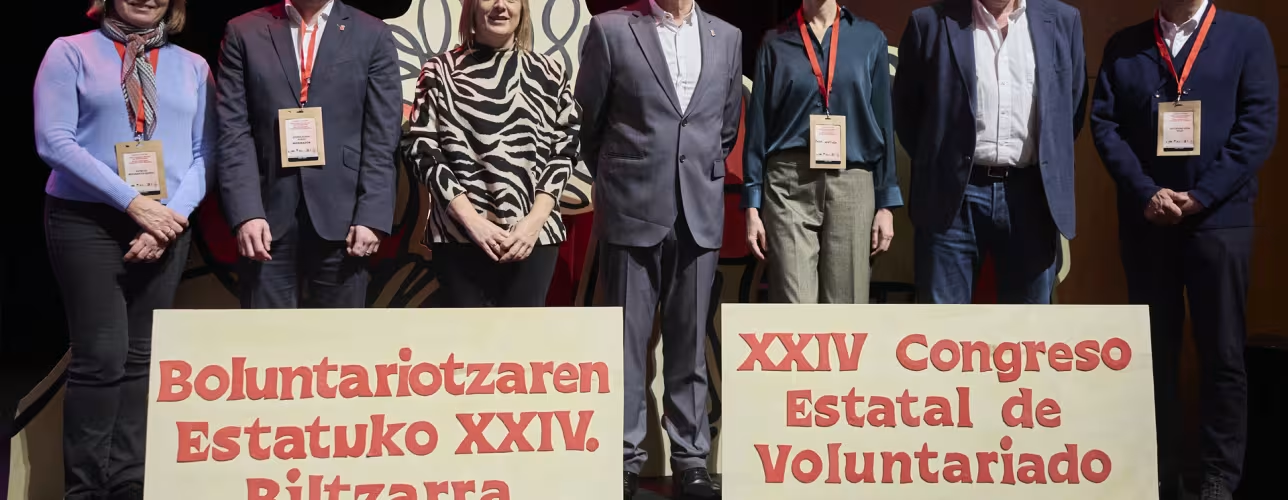
Navarra hosts the forum where solidarity inspires and shapes the future of volunteering
Today and tomorrow, Navarra becomes the heart of solidarity in action. The Navarra Conference and Auditorium Centre–Baluarte is hosting the 24th National Volunteer Congress, which brings together in Pamplona‑Iruña key stakeholders in volunteering at local, regional and national levels.
This is an event promoted by the Ministry of Social Rights, Consumer Affairs and the 2030 Agenda in collaboration with the regional government, with the participation of the Spanish Volunteer Platform, the Navarra + Voluntaria Platform—managed by the public company NASERTIC—as well as Navarrese volunteer organisations.
The Congress is taking place at a time marked by collective reflection on the future of volunteering and on the forthcoming Foral Law on Volunteering, a draft bill arising from a broad deliberative process involving sector organisations, volunteers, public administrations and various private organisations from Navarrese society.
Taberna advocates for transformative volunteering
The First Vice President and Minister of Presidency and Equality, Félix Taberna, took part in the official opening of the Congress during a round table that also featured María Rosa Martínez, Secretary of State for Social Rights; Joseba Asirón, Mayor of Pamplona; and Saturnino Peña of the Spanish Volunteer Platform.
Taberna stressed that volunteering rests on a fundamental idea: transformation, which operates on four dimensions. At the collective level, he noted that, in the face of today’s individualism, volunteering reminds us of the importance of the common good and of looking beyond oneself. On a personal level, he recalled that “giving transforms,” as participation in solidarity projects provides self‑esteem, social skills and a sense of purpose.
He also highlighted the transformation of reality, because each voluntary act shows that the world can change, even through small actions—“the rebellion of the everyday,” in his words. Finally, he referred to the shift in perspective, since volunteering connects people and contexts that would otherwise never coincide, thereby broadening the way we understand the world.
“Volunteering is a chain of transformations, a domino effect of solidarity that continues to multiply,” the Vice President concluded.
Debate and reflection on the future of volunteering
The Congress is being held in a context of reflection on the future of volunteering and on the new Foral Law on Volunteering, a law conceived with the aim of placing Navarra at the forefront of social commitment and consolidating it as a benchmark territory in civic humanism and solidarity.
The new regulation seeks to recognise all forms of civic commitment and adapt them to the times, incorporating areas such as business, the business sector, universities and the digital sphere. Among the main new features, corporate volunteering is regulated as an expression of social responsibility that strengthens organisations and expands their community impact.
The draft bill also regulates volunteering within the education system and promotes partnerships among universities, social organisations and administrations, understanding volunteering as a “school of citizenship.” It likewise reinforces its inclusive nature through accessibility and support measures that enable participation by people with disabilities as active agents of solidarity.
The text guarantees training and skills accreditation for volunteers, creates the Volunteer Action School and allows young people aged 12 to 16 to take part in volunteering activities, provided these do not interfere with their development or academic training. In addition, it defines the rights and duties of volunteers, ensuring their participation in all phases of programmes and their social and institutional recognition.
The culture of volunteering as a way of thinking, feeling and acting with others
The Congress includes two inspiring talks by Guillermo Dorronsoro, Management Board Advisor at Zabala Innovation Consulting and professor at Deusto Business School, and Cristina Monge, political analyst and researcher in governance for the ecological transition.
Through various dialogue panels, issues are addressed such as artificial intelligence and new technologies as transformative tools at the service of society; network building and collaboration among administrations and stakeholders; the challenge of disinformation; disaster response; as well as the gender perspective in volunteering, among other topics.
The programme also includes a an experience-sharing session in which volunteers share their stories, learning and motivations in their respective fields of action.
As part of the Congress, the National Volunteer Awards and the 2025 Navarra Volunteer Distinction—the highest recognition granted by the Government of Navarra to highlight people who stand out for their dedication to volunteering or for their social example—will be presented. In this edition, the distinction goes to paediatric surgeon Carlos Bardají, recognised for three decades of cooperative commitment in Senegal and Gambia.
Spirit of the Congress
Under the slogan “The pulse that unites us, the intelligence that moves us,” the Congress highlights the shared heartbeat of thousands of people who, through generosity and commitment, help build a more humane society.
The slogan arises from the union of two ideas that encapsulate the essence of volunteering and its future vision. “The pulse that unites us” refers to the invisible yet decisive energy that connects those who offer their time, their attention and their support. A shared pulse that sustains a living network present throughout the territory, capable of supporting, mobilising and transforming.
For its part, “the intelligence that moves us” recalls that volunteering is not only action, but also reflection, creativity and vision. In a context shaped by the advance of artificial intelligence, the sector likewise asserts the importance of emotional intelligence: empathy, presence and the capacity to see the other. Gestures that no technology can replace.
Source: navarra.es


