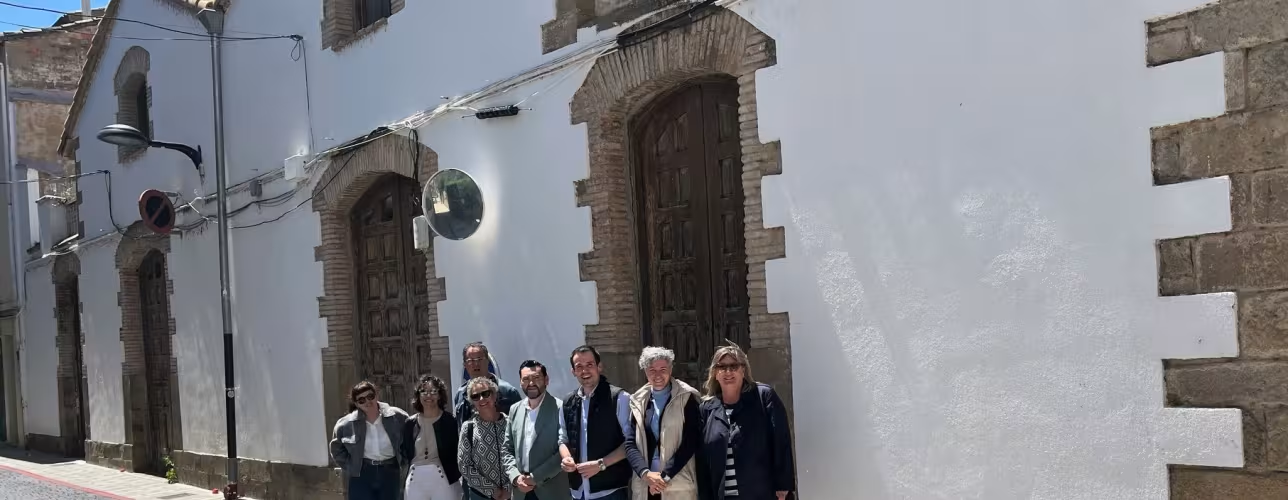
Territorial Cohesion promotes the renovation of the former Sangüesa slaughterhouse as the headquarters of the Territorial Innovation Center
The Territorial Innovation Center (CIT) of Navarra in Sangüesa / Zangoza will be located in the former municipal slaughterhouse, a space of nearly 300 square meters, which will be rehabilitated through an agreement signed between the Department of Territorial Cohesion, via the Directorate General of Local Administration and Depopulation, and the Sangüesa City Council.
The Director General of Local Administration and Depopulation, Jesús María Rodríguez, accompanied by representatives of the public companies of Navarra, NASERTIC and Nasuvinsa-Lursarea, and the Mayor of Sangüesa, Javier Solozábal, along with members of the municipal council, held a first meeting today to advance the CIT of Sangüesa, designed to fight depopulation by bringing innovation to the territory to retain and attract talent.
In this regard, Jesús María Rodríguez highlighted the potential of the Sangüesa region “to work together with its socioeconomic fabric to reverse the factors that drive depopulation.” He also expressed “his full confidence that from the headquarters of the CIT of Sangüesa, services can be provided to all public and private local entities in the territory, ensuring that rural innovation becomes a true lever for local development.”
Along the same lines, the Mayor of Sangüesa thanked “the opportunity the CIT offers to Sangüesa and the surrounding region as a tool to contribute to economic development, help prevent depopulation and improve citizens’ well-being.”
At the end of the meeting, a visit was paid to the former slaughterhouse. The building has 206 square metres of interior space and a further 68 square metres of outdoor divided into two courtyards. The facilities will be renovated using sustainable materials and adapted to ensure minimal energy consumption.
The Director General of Local Administration and Depopulation announced that in the coming weeks a property transfer agreement for the former municipal slaughterhouse will be signed between the Sangüesa City Council and the Government of Navarra, which will also include the commitment to co-finance the renovation works for the space. The building will house two offices, a coworking area and open spaces for potential uses such as exhibitions, showrooms or workshops.
In addition, in the coming weeks an agreement will be signed between the Ministry for Ecological Transition and the Demographic Challenge and the Department of Territorial Cohesion, which will formalize a four-year collaboration between both administrations for the creation, promotion and development of the Territorial Innovation Center of Navarra, which will have headquarters in Estella-Lizarra and Sangüesa. The total cost of the planned actions under this agreement amounts to 833,333 euros, of which the Ministry will contribute 500,000 euros and the regional government 333,333 euros.
What the CIT Is
The Navarra CIT, owned and coordinated by the Government of Navarra, aims to promote territorial equity in the Comunidad Foral and address depopulation. The CIT is conceived as a collaborative workspace bringing together key stakeholders from the business sector, innovation and technological development organizations, local entities and the regional government to propose and develop innovative collaborative projects that strengthen the competitiveness of the socioeconomic fabric in municipalities at high risk of depopulation. It will also serve as an access point to technologies and innovative processes, as well as training and advisory services in social and technological innovation.
The Navarra CIT forms part of the Network of Territorial Innovation Centres (CIT Network), promoted by the Ministry for the Ecological Transition and the Demographic Challenge, which already comprises eleven other centres across Spain. These are strategic spaces operating at provincial or multi-provincial level, conceived as collaborative ecosystems designed to develop and share initiatives aimed at revitalising rural areas, particularly those facing high levels of depopulation.
Source: navarra.es